

Seychelles Hosts Regional Training on Meteorology, Climatology and Hydrology Database
The Seychelles Meteorological Authority (SMA) hosted the World Meteorological Organization (WMO) Meteorology, Climatology and Hydrology (MCH) Database Regional Training from 20 to 28 August 2026 in Seychelles.
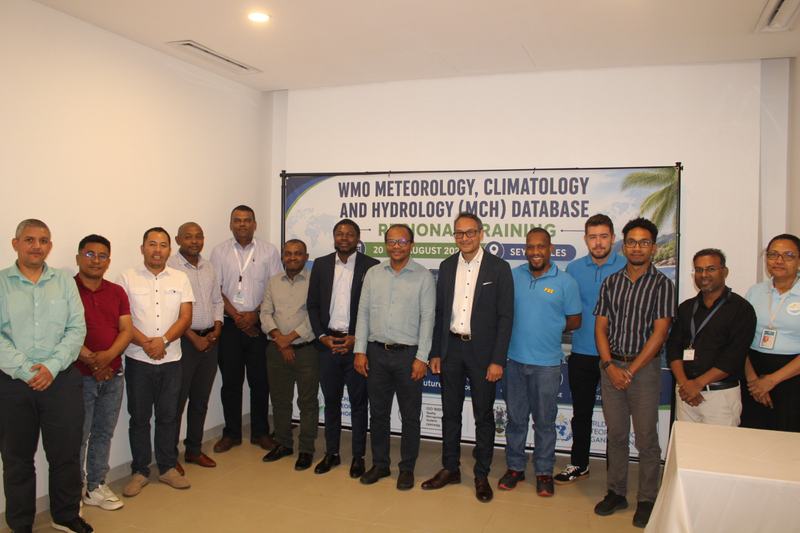
Organized with the support of the World Meteorological Organization (WMO), the regional training strengthened participants’ practical knowledge and technical skills in the operation, administration and effective use of the MCH database. It also provided an opportunity for participants to exchange experiences and discuss common practices and operational requirements relating to the management of meteorological, climatological and hydrological data.
The MCH Database Management System provides National Meteorological and Hydrological Services with a structured platform to manage large volumes of observational data. This includes data from weather and hydrological stations, as well as historical records that are essential for understanding long-term weather, climate and water patterns.
Beyond storing data, the system allows users to carry out quality control, processing, analysis and visualization. From these records, services can develop a range of products including daily, weekly, dekadal, monthly and annual summaries; rainfall and temperature statistics; climate normals; tables; graphs; maps; and data-availability reports. These products can support climate monitoring, research, water-resource assessment, planning and the provision of information to sectors that depend on reliable weather, climate and hydrological information.
For SMA, strengthening the management of meteorological and hydrological observations through MCH also complements operational systems such as the Flash Flood Guidance System (FFGS). The MCH training followed closely after the South-West Indian Ocean Flash Flood Guidance System (SWIOFFGS) training, held from 17 to 19 August 2026 and also hosted by Seychelles, providing participants with two consecutive opportunities to strengthen regional capacity in hydrometeorological data management, forecasting and early warning. While MCH focuses on the management, quality control, preservation and analysis of observational data, FFGS supports forecasters in assessing flash-flood potential using rainfall information, soil conditions and modelling guidance.
Historical rainfall and hydrological records managed through MCH can provide valuable context for evaluating heavy rainfall and past flood events, while FFGS provides more immediate guidance for identifying areas at risk of flash flooding. Together, the two systems strengthen the link between data management, analysis, forecasting and early warning, supporting more informed and timely decision-making and contributing to stronger hydrometeorological services across the region.
The training also highlighted the importance of maintaining high-quality historical datasets. Long-term records are not only valuable for day-to-day operations but are increasingly important for understanding climate variability, monitoring changes in rainfall and temperature, assessing extreme events and supporting evidence-based planning.
By hosting the regional training, SMA contributed to strengthening technical capacity and regional cooperation in meteorological, climatological and hydrological data management. The knowledge gained during the programme can support participants in making better use of their national datasets and in developing more reliable and user-oriented products and services.
The training ultimately reinforced the important role of effective data management in modern meteorological and hydrological services, where accurate observations, reliable databases and operational forecasting systems must work together to support informed decision-making and stronger early warning services.