

Favourable Weather Supports Two Successful STRATEOLE-2 Balloon Launches in Seychelles
Favourable Weather Windows Allow Two Successful Balloon Launches for STRATEOLE-2 Scientific Campaign in Seychelles
Despite challenging weather conditions influenced by a strong El Niño, two successful balloon launches on consecutive nights, on 22 and 23 October 2026, mark important progress in the ongoing international atmospheric research campaign.
The Seychelles Meteorological Authority (SMA), in collaboration with its international partners, is pleased to report the successful launch of two long-duration stratospheric balloons on Thursday, 22 October, and Friday, 23 October 2026, as part of the ongoing STRATEOLE-2 scientific campaign.
The launches were made possible by a temporary improvement in weather conditions, allowing the scientific and technical teams to take advantage of favourable weather windows following a particularly challenging period of rainfall and strong winds.
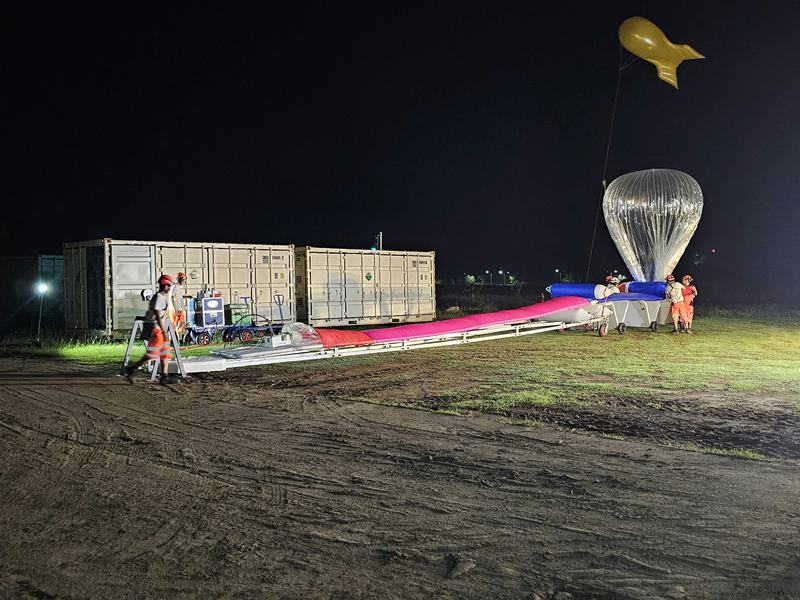
Both balloons were launched during night-time operations from the SMA Upper Air Station at Seychelles International Airport, marking encouraging progress for this important international scientific campaign led by the French space agency, the Centre National d’Études Spatiales (CNES), with the support and coordination of SMA.
Weather Conditions and Night-Time Launch Windows: A Major Operational Challenge
Weather conditions play a critical role in determining when the balloons can be launched. The preparation, inflation and release of these large, long-duration stratospheric balloons require carefully controlled conditions, particularly the absence of rainfall, sufficiently light winds and other favourable meteorological factors.
Rainfall can affect the delicate balloon materials and sensitive scientific equipment, while strong or gusty winds can make balloon handling and inflation difficult and potentially unsafe. As a result, launches cannot proceed unless the necessary weather and safety requirements are met.
An additional challenge is that launches must be conducted during specific night-time windows authorised by the aviation authorities. Since the launch site is located at Seychelles International Airport, all operations are closely coordinated with the Seychelles Civil Aviation Authority (SCAA) and Seychelles Airports Authority (SAA) to ensure aviation safety and minimise disruption to airport operations.
The teams must therefore wait for two essential conditions to coincide: a suitable weather window and the availability of an authorised aviation launch period. This requires continuous weather monitoring, careful preparation and considerable operational flexibility.
The 2026 campaign is proving particularly challenging due to the strong El Niño event, which is influencing weather patterns across the region. Seychelles has been experiencing periods of extreme rainfall and strong winds, creating significant difficulties for the preparation and launch of the balloons. These conditions have placed additional pressure on the scientific and operational teams, requiring them to remain on standby and respond quickly whenever the weather improves.
The successful launches on 22 and 23 October demonstrate the importance of taking advantage of every favourable opportunity while maintaining the highest safety standards.
Seychelles' Important Contribution to International Atmospheric Research
STRATEOLE-2 is a major international scientific campaign designed to improve understanding of the equatorial upper troposphere and lower stratosphere, a region of the atmosphere that plays a critical role in global weather and climate processes but remains relatively under-observed.
Seychelles was selected as the launch location not only because of its strategic geographical position in the equatorial Indian Ocean, which provides an ideal setting to investigate atmospheric circulation and processes occurring in the tropical atmosphere, but also because of the strong cooperation and close working relationships established between the project partners, the Seychelles Meteorological Authority and the relevant national authorities.
The balloons operate at altitudes of approximately 18 to 20 kilometres and can remain in flight for several months, drifting with atmospheric winds across the equatorial region. They carry sophisticated scientific instruments capable of collecting detailed observations of temperature, pressure, winds, water vapour, ozone, aerosols, clouds, radiation and other atmospheric parameters. These observations provide valuable information that is difficult to obtain through conventional meteorological observing systems. The research will help scientists better understand atmospheric circulation, the transport of water vapour, and the interactions between different layers of the atmosphere. The ultimate objective is to contribute to improved weather forecasting, more accurate atmospheric modelling and better climate predictions, benefiting not only Seychelles but also the wider international community.
Seychelles has already played an important role in this unique scientific programme, having previously hosted STRATEOLE-2 campaign phases in 2019 and 2021, with the support of SMA and other national authorities. The first phase focused on validating the balloon systems and their operational capabilities, while the subsequent phase expanded scientific observations of the tropical atmosphere. The ongoing 2026 campaign builds on these earlier achievements and further strengthens Seychelles' contribution to international meteorological and climate research.
The programme brings together approximately 60 international experts from participating countries, including France, the United States, India, Japan and Seychelles. The observations collected will also be made available to the wider international scientific community, with relevant meteorological data shared through established international systems, including the World Meteorological Organization's Global Telecommunication System.
Scientific reports and publications presenting results from the STRATEOLE-2 research programme are expected to become available, providing further insights into the complex atmospheric processes being investigated and their implications for weather forecasting and climate science.
Extensive Logistics and Continued Efforts to Complete the Campaign
Conducting an international scientific campaign of this magnitude involves considerable logistical planning, technical preparation and close coordination among numerous partners.
The deployment of specialised equipment, transportation and preparation of balloons, installation and testing of scientific instruments, mobilisation of international experts, continuous weather monitoring and coordination of night-time launches all require significant resources and operational effort.
SMA plays an important role in facilitating the campaign at the national level, working closely with CNES, aviation authorities, relevant government institutions and other partners to ensure that operations are conducted safely and in accordance with applicable national regulations and aviation procedures.
The two successful launches represent not only important milestones for the scientific campaign but also the collective efforts, dedication and close cooperation of the many teams involved. Following the successful launches on 22 and 23 October, the STRATEOLE-2 team remains hopeful of launching the remaining 22 balloons by mid- December 2026, subject to favourable weather conditions and the availability of authorised aviation windows.
Although the prevailing weather conditions continue to present significant challenges, the teams remain committed to making the most of every suitable launch opportunity. The balloons already deployed will continue their missions, collecting and transmitting valuable atmospheric observations as they drift across the equatorial region.
Through its continued involvement in STRATEOLE-2, Seychelles is reaffirming its commitment to international scientific cooperation, strengthening its role in global atmospheric research and contributing to efforts to improve weather forecasting and climate prediction.
The Seychelles Meteorological Authority remains fully committed to supporting this important international initiative and looks forward to further successful launches as weather conditions permit.