

SMA and Chinese Partners Successfully Deploy Two Ocean Monitoring Buoys in Seychelles Waters
The Seychelles Meteorological Authority (SMA), together with its Chinese partners, has successfully completed the deployment of two ocean monitoring buoys in Seychelles waters, marking an important step forward in strengthening national weather, ocean, climate, and marine environmental observation systems.
The first deployment took place on 27 April, when a meteo-oceanographic buoy was deployed at 4º34'S and 55º21'E. The second deployment followed on 28 April with the successful positioning of a sediment trap buoy, which was dropped in an area with a water depth of 500 metres. Together, the two instruments will support the collection of essential data from both the sea surface and the water column, strengthening Seychelles' ability to monitor weather, ocean, climate, and marine environmental conditions.
The operation began with the successful boarding of the deployment team and equipment from the Port of Victoria before the vessel proceeded to the designated deployment areas. Upon arrival, the technical teams safely positioned and deployed the buoys, completing a key phase of this joint scientific mission.
The deployments reflect the strong spirit of cooperation between Seychelles and China. The buoys were contributed through this partnership, demonstrating the continued goodwill, technical collaboration, and shared commitment to improving scientific observation and environmental monitoring in Seychelles waters.
SMA extends its appreciation to the Seychelles Ports Authority, Seychelles Coast Guard, vessel crew, divers, technical teams, and all personnel involved in the successful completion of the deployment operations on 27 and 28 April. SMA also thanks the Ministry of Environment, Climate Change and Energy, the Seychelles Bureau of Standards (SBS), and Health Care Laboratory for providing mercury chloride and sodium chloride, respectively, which were needed for the deployment of the sediment trap buoy. This achievement demonstrates that when partners come together for a common goal, much can be achieved.
With both buoys now deployed, SMA reaffirms its commitment to advancing national observation systems and strengthening services that benefit environmental monitoring, marine safety, climate resilience, and national development.
What the meteo-oceanographic buoy does
The meteo-oceanographic buoy is designed to collect weather and ocean data from the marine environment. It supports the monitoring of key conditions such as wind, air and sea temperature, atmospheric pressure, wave conditions, and other oceanographic parameters. This information is important for improving weather forecasting, marine forecasts, climate monitoring, and early warning services.
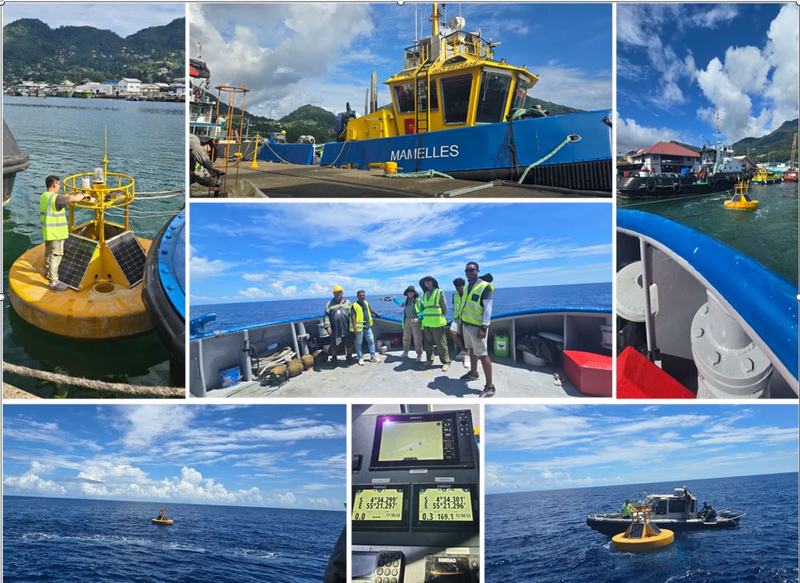
For Seychelles, a small island developing state surrounded by a vast ocean area, this type of real-time or regular marine observation is especially valuable. Better data from the ocean helps forecasters understand developing weather systems, improve warnings for rough seas and strong winds, and support safer decision-making for fishers, boat operators, shipping, tourism operators, and coastal communities.
What the sediment trap buoy does
The sediment trap buoy is used to study particles that move through the water column and settle toward the ocean floor. Sediment traps are designed to collect tiny sediment particles and larger accumulations of marine snow, which can include organic matter, dead marine organisms, tiny shells, dust, and minerals. By collecting these sinking particles at depth, the buoy helps scientists better understand sediment movement, water quality, marine productivity, nutrient cycling, and how material from the surface ocean is transferred to deeper waters.
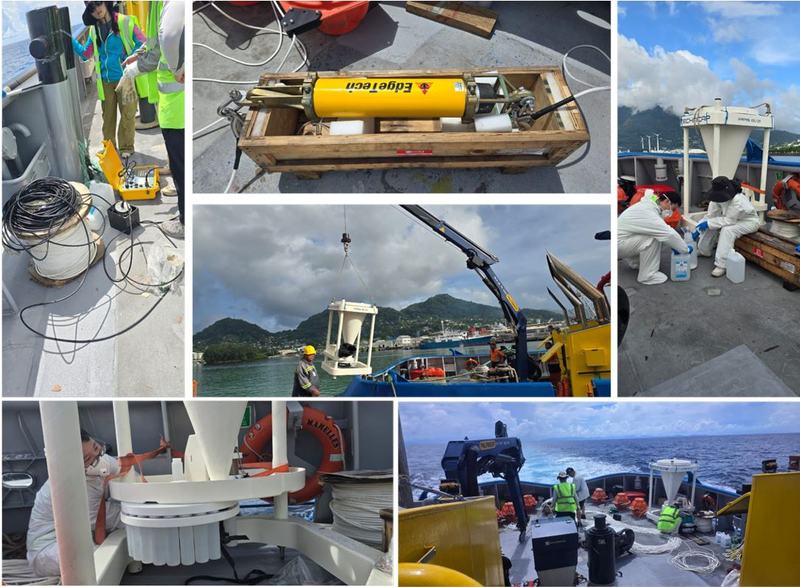
Because the buoy was placed in deep water of 500 metres, it can provide valuable information from below the surface layer, including changes within the water column. Information linked to water-column temperature is especially important, as temperature influences ocean circulation, stratification, marine habitats, and the movement of nutrients. For Seychelles, this knowledge is directly relevant to climate change monitoring, as warming seas and changes in ocean conditions can affect coral reefs, fisheries, and the wider blue economy. Better understanding these changes can support coral reef protection, marine conservation, and evidence-based management of Seychelles' ocean space.
Why the deployments matter for Seychelles
The successful deployment of both buoys strengthens Seychelles' capacity to observe and understand its surrounding ocean. The meteo-oceanographic buoy provides information on weather and sea conditions at the surface, while the sediment trap buoy adds scientific insight into processes occurring below the surface and through the water column. Together, they provide complementary observations that can help connect surface weather and ocean conditions with deeper marine processes.
The data generated will contribute to improved forecasting, climate and marine research, disaster risk reduction, maritime safety, fisheries and coastal management, and evidence-based decision-making. It will also support Seychelles' wider national priorities, including climate resilience, protection of coral reef ecosystems, sustainable use of marine resources, and stronger preparedness for climate-related ocean changes.